via:
http://samvada.org/2015/news/azim-premji-gmr-rao-mohan-bhagwat-at-seva-sangam/
India’s most noted Industrialists from Bengaluru, Azim Premji of
Wipro, Grandhi Mallikarjuna Rao of GMR group attended the second day
proceedings of 3-day ‘Rashtriya Seva Sangam’, along with RSS
Sarasanghachalak Mohan Bhagwat at New Delhi on Sunday.
Full text Speech by AZIM PREMJI given below:

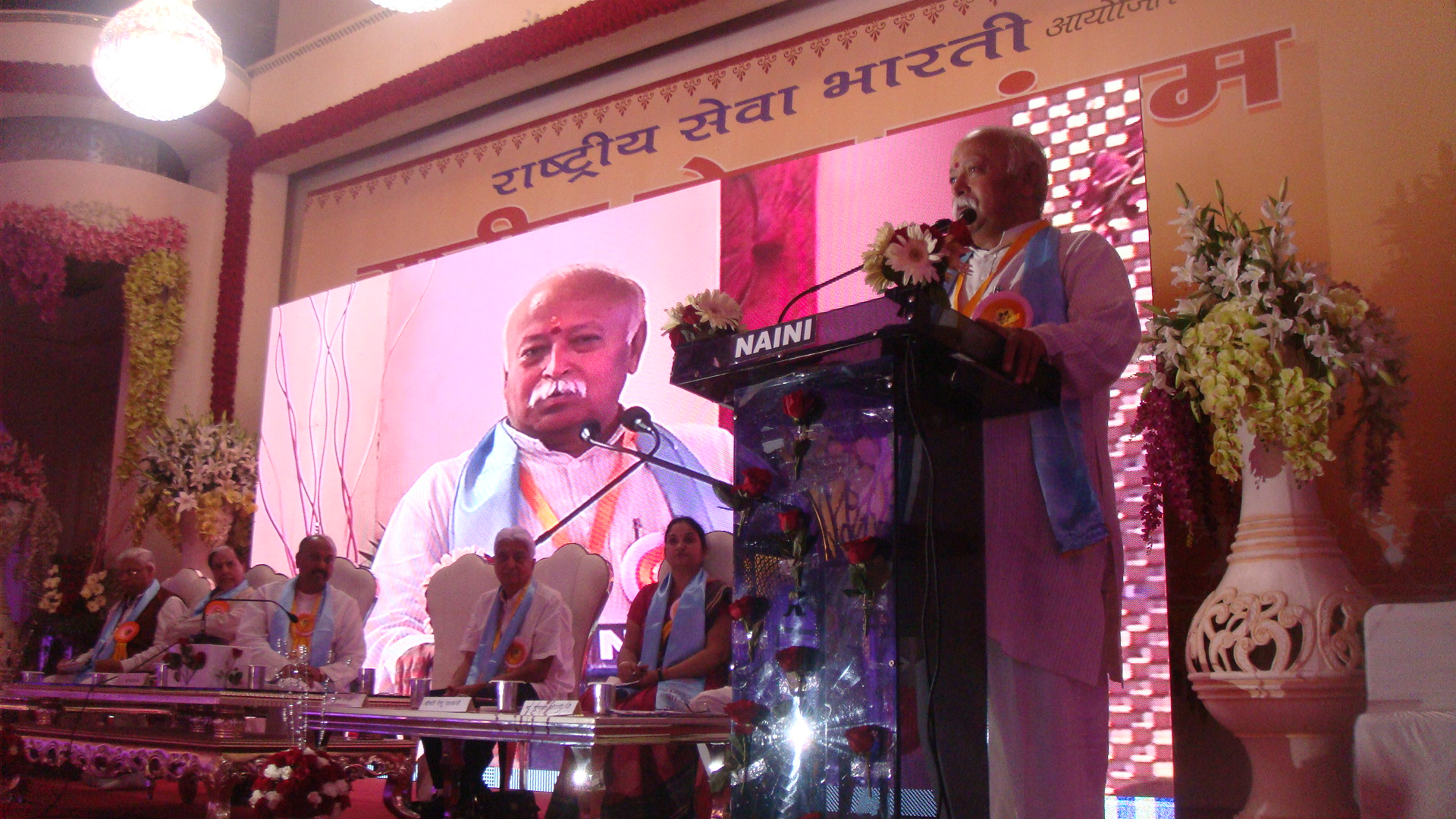
RSS Sarasanghachalak Mohan Bhagwat speaks at Rashtriya Seva Sangam, New Delhi

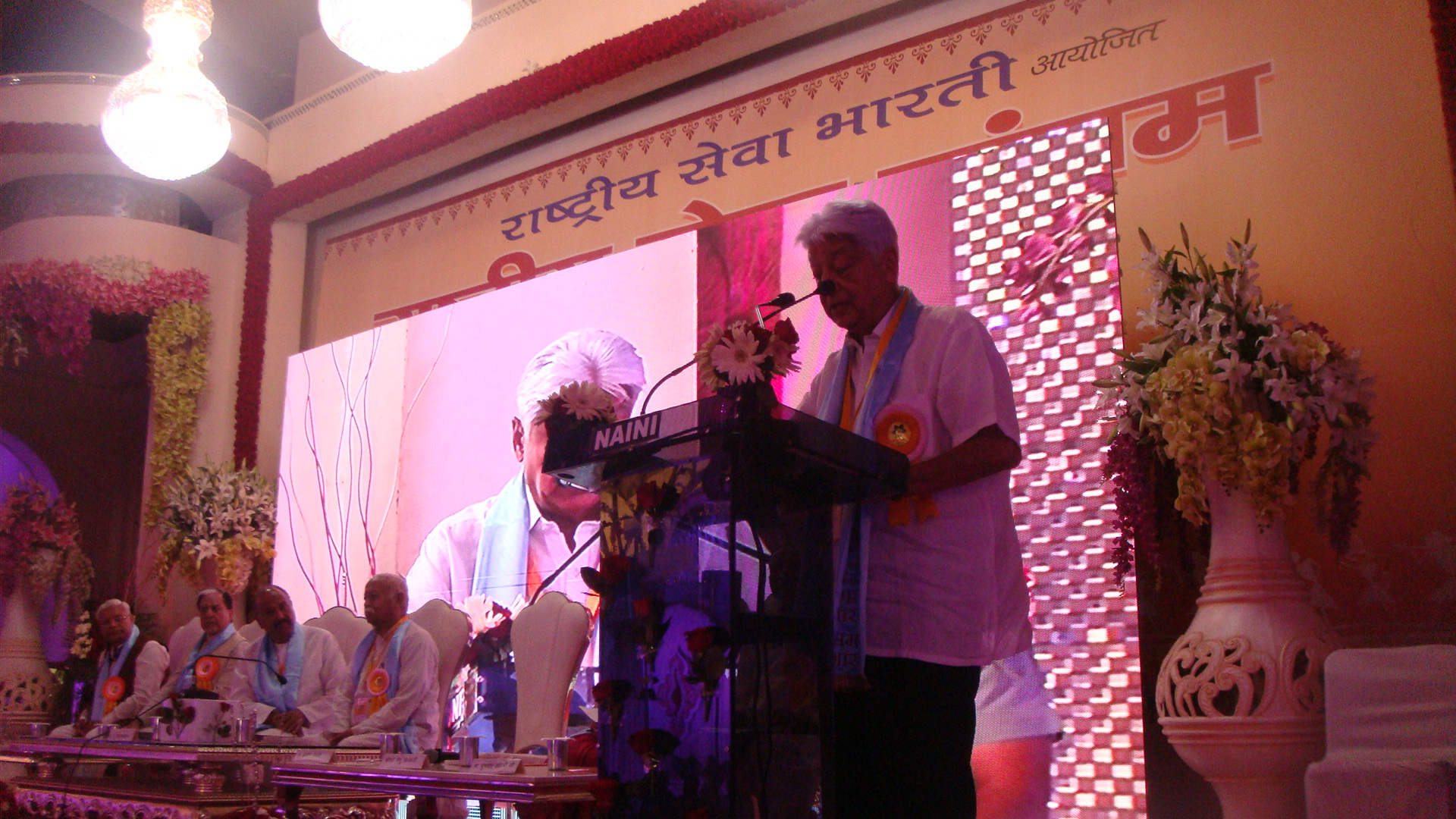
Wipro Chief Azim Premji speaks at Rashtriya Seva Sangam, New Delhi
Full Text of Speech of Azim Premji at Rashtriya Sewa Sangam :
Ladies and Gentlemen, Namaste
Everyone present at this meeting is present here because we all share a
belief that we must work together for a better India. I understand that
most of you here today are already working towards translating this
belief into a reality with your hard work in the field, and that many of
you have dedicated your entire life to this cause.
It is a great privilege to be invited to speak on this occasion and a
pleasure to be here amongst people who are not only dreaming of a better
India, but are actually dedicating their lives to it.
I must share with you how I happen to be here with you today. It was
Mohan Bhagwatji who honored me by inviting me to speak on this occasion.
However, some people expressed apprehension about my participating in
this function.
They felt that by addressing a forum like this I would be seen as endorsing the ideology of the Sangha.
I did not follow their advice because:
Firstly, I am not a political person. I am however
deeply interested in and concerned about my country. So I see no issue
in speaking at an occasion where people have gathered to discuss how to
contribute to the country. Also, I believe that merely speaking at a
particular forum does not in any way mean that one endorses all, or any,
of the views that might be expressed at the forum, or which may be held
by the organizers.
Secondly, while I myself may not know many of you here,
some of my colleagues do know some of you and, more importantly are
acquainted with the good work being done by many present here for the
genuine betterment of our country, and I did not want to miss this
opportunity of speaking with you.
Thirdly and most importantly, after having met Mohanji,
I realized how many people like you all over India, were dedicating
their lives to the genuine upliftment of our country, with deep
commitment to their work. And I thought, all those working towards a
better India, should attempt to join hands where they can. And if there
are differences of views or divergence of ideas they can only be
resolved through discussion and dialogue. That is why I am here with you
today at this very large gathering of dedicated people. When I speak of
a better India, I visualize the India envisioned in our
Constitution, an India which is just, equitable, humane and
sustainable. Such an India must be not only economically strong to be
able to provide to all its citizens with shelter, nutrition, access to
basic health and education, but at the same time it must be an India
with great heart, which treats all living entities – human beings and
nature – with care and compassion. If we are to become a great country,
and realize the vision of our constitution, we need to work on many
fronts. Let me refer to just some of these issues.
We must improve our governance and battle corruption at every level so
we can release our energy for the betterment of our country and the
world. We must make our country safe for our citizens and especially for
our women, our children and the disadvantaged sections. We must work
towards providing shelter to those who live in abject poverty, and
ensure that every one gets a decent meal, access to healthcare and
good Education.
We must act on these and many other fronts if we are to fulfill our
own aspirations of a good society and as a nation become an important
and meaningful member of the global society.
I believe that one of the foremost areas we need to address is Education.
When I first decided to set up a foundation, I considered many areas
that needed urgent redressal in our country- livelihoods, health,
education and environment amongst others. After much deliberation, I
decided upon Education as a priority because I believe that a well
educated population will be empowered to take care of its other problems
such as livelihood, health, sustainability etc. Since Education is my
area of interest, I hope you will not mind my talking a little more
about it.
Our Education system needs a great deal of improvement, not only in
ensuring that all our children, especially from the deprived section are
in school, but much more importantly in the quality of Education. We
know that Education is most fundamentally empowering for any human being
and thereby for the nation. Unfortunately at this point our Education
system is not delivering as it should. Let me briefly touch upon what I
think is good Education. In my view, and as reflected in several
National Policy documents and curricular goals, good Education is that
which enables the growth and development of the child in multiple
dimensions, such that she is able to fulfill
and expand her potential and become an active, contributing and
concerned citizen of our country and the world. These multiple
dimensions of development of the child include not just the cognitive,
but also the physical, social, emotional and ethical development of each
child. And this must happen in an integrated manner.
Good Education is not about rote memorization and getting good grades,
it’s about ability to think critically, to question, and to develop the
individual’s autonomy. Good Education is about developing good human
beings, who are empowered to make informed and ethical decisions, and
who grow into responsible and caring citizens. And most importantly,
good Education is that which in its totality enables the development of
our country, as envisioned in our Constitution.
There is a tremendous need for improvement in both our school and
higher Education sectors. We at the Azim Premji Foundation decided to
work single mindedly in the area of school Education, in which we have
now been engaged for 15 years. Our focus has been totally on helping to
improve the quality of education in the government schooling system. We
chose this path because the mandate of government schooling, or the
public education system as it is called is to serve children from all
sections and all sectors of society including the underprivileged
without any discrimination, a clear mandate to serve the most
disadvantaged sections of our society. Our work, currently in the
states of Uttarakhand, Rajasthan, MP, Chhattisgarh, Karnataka and Bihar,
which have over 350,000 schools, work is entirely focused on helping
improve the States’ schooling systems, especially in the disadvantaged
districts of these states.
In 2010, after ten years of experience of working in the field, we
realized that a major problem was the great dearth of good Educational
professionals in the field, decided to establish the not-for-profit Azim
Premji University, for educating professionals, experts in the field
Education and other human Development areas, who would be committed to
working in the social sector.
Based on our work in school education, let me share with you a few
points that strike me as pivotal in improving our public school
system: First, all of us including the Government, needs to strongly and
visibly reaffirm the importance of quality public Education, because
public Education is foundational to democracy. It helps break down
social and economic inequalities and helps build an egalitarian,
inclusive society. We see that even
the most economically advanced nations invest and develop a strong
public Education system as they realize its critical value to society
and democracy.
Our aim should not be to create a parallel system of private schools,
but to revamp and enable the vast existing public system which today
reaches almost every village in our country. It is imperative that we
revitalize this system. Second, the problem is while we have many
excellent policies and intentions, our execution on the ground has been
very weak. We must focus on execution and implementation on the ground.
Third, improving the entire Education system is only possible if we
carry all stakeholders with us. This means that not only must all the
states be committed and its institutions involved, but most importantly
that our millions
of Teachers be motivated to change.
We must recognize the critical role of Teachers and make them
partners in the change. This will only happen if we value our Teachers,
give them adequate voice, empower them and acknowledge the importance of
their role. Like any other area of work, some of our existing Teachers
are highly capable and committed, while some are disengaged. However
most teachers are like the average human being, like you and me, who,
with the right education, adequate support and an empowering
environment, can become the back bone of our efforts to improve
education.
Fourth, improving the Teacher Education system, including the B. Ed.,
D.Ed. colleges is crucial if we want to develop good teachers.
Unfortunately many of our 16000 odd Teacher colleges are more of
commercial institutes with no real interest in Education. These are
often owned by powerful people who resist attempts at change. So,
reforming the system will be a daunting challenge which will take
political will, commitment and courage. But unless we do this, our
school Education will not improve for a long long time. Fifth, we must
make sustained and systematic efforts to develop the capacity of
existing teachers by providing comprehensive on the ground support
in multiple ways, including opportunities and mechanisms for peer
learning. This will require revamping our Cluster and Block Resource
Centers as well as our 600 odd existing District Institutes of
Educational Training (DIETs) which can
then take the lead in addressing the multiple needs of school Education, including capacity development of Teachers.
Sixth, it is also most important to improve early childhood care for our
preschool children to ensure they receive proper nutrition and early
Education, as this foundation is crucial for the healthy, all round
development of the child.
At present we have a 13 lakh strong network of Anganwadis which we
must invest in and improve to ensure a sound foundation. Lastly, to make
all this happen we will have to significantly increase
public investment in Education which at present is woefully inadequate.
Illustratively, our public expenditure for school Education is only 2.8%
of our GDP, while that of other developing countries is over 3.5% and
developed countries which have good Education systems 5% to 6% of GDP.
This calls for political will and prioritization.
The issues I have raised are not the only ones in Education, but I do
think they are some of the most important ones. If we want our
Education to fundamentally improve, we will have to seriously take up
the above challenges. If we really want to fulfill this huge agenda we
will all have to work together, as such an agenda will require not only
very strong political will but an enormous amount of commitment – “tann,
mann and dhan”. Dedicated workers like you will need to take on
ownership for those aspects of the agenda which find resonance in your
own work, and also influence public discourse on these issues. Given the
importance of good Education to every individual and to the
overall society, I am sure that many of you must be already engaged in
working in many of these areas. I want to reiterate that we as a
Foundation, are deeply committed to improving the public school system. I
think that all players in the Education arena need to work together
towards developing a robust, vibrant, high quality and inclusive Public
Education System.
As I come to a close, let me leave you with a few thoughts. One, for me
Values are very important. I have learnt that this is true for
small actions as well as big ones, for what we are, is revealed not in
big things but in the little things we do. I believe there is nothing
more important than Integrity. Building a culture of integrity in an
organization is about trying to be consistently straightforward in all
actions and words with all people, including in our own daily
interactions and commitments. Two, the test of our social commitment and
humanity is how we treat the most powerless of our fellow citizens, the
respect we accord to our fellow human beings. That is what reveals our
true culture. Three, as a great pluralistic nation we must accept our
differences. It is vital that we accept them and find a common ground to
work together. Negative people only focus on differences. How
empowering it would be for us as a nation if we focus on common causes.
Instead of dissipating our energy on dissonance and discord, imagine all
125 crore Indians working together to battle our greatest common
challenges – poverty, inequality, ignorance, disease – what a great
country we could be!
I would like to thank you once again and to reiterate what an honour it
has been for me to be able to address so many good people doing so much
good work with such great social purpose. You indeed form a part of
vibrant civilsociety of India, so essential in any great nation. Let us
hope that our country awakens, and that we all together bring to reality
the great India envisioned in our constitution.
Thank you and Jai Hind
–
Azim Premji, New Delhi April 05, 2015

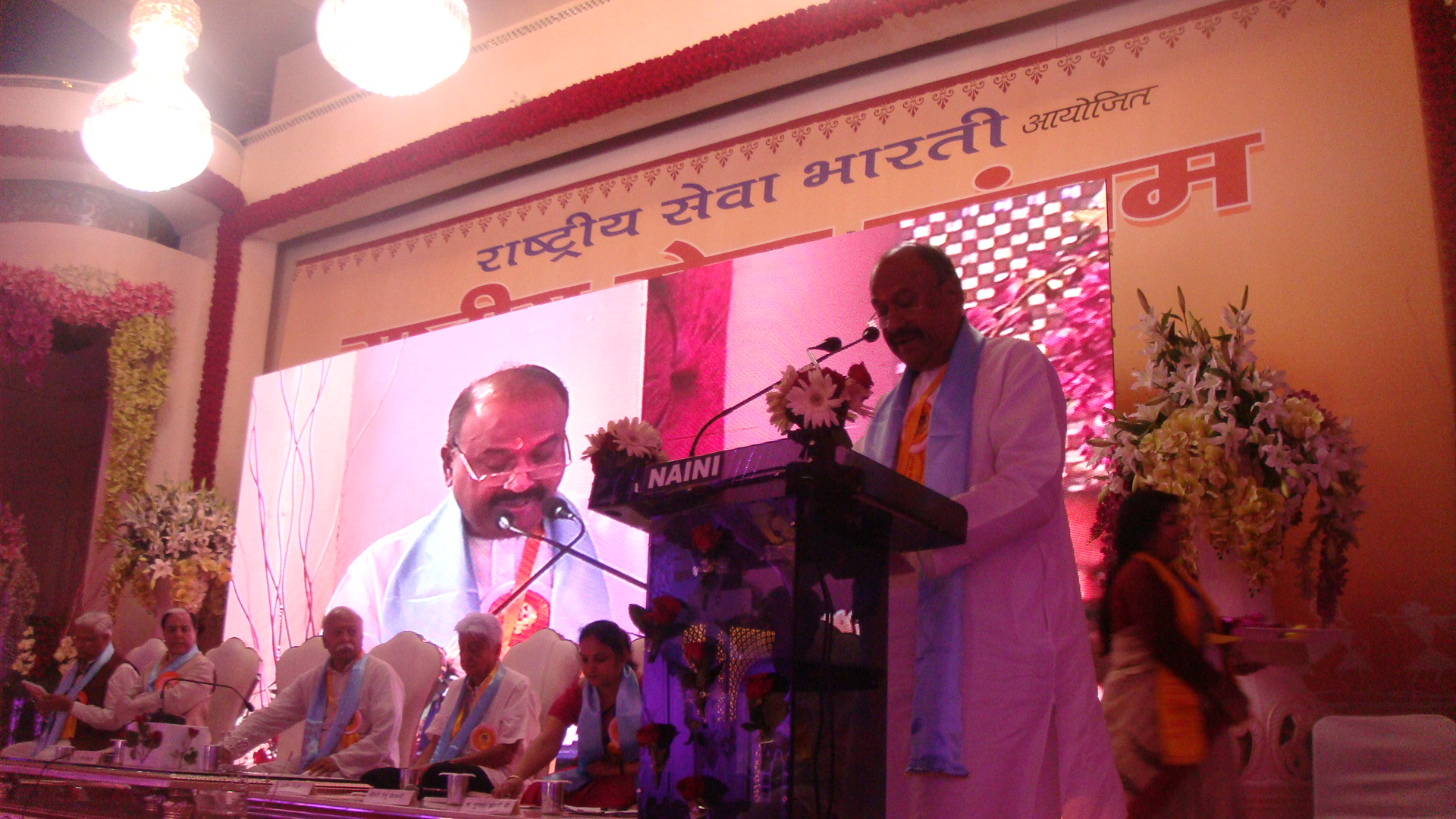
Grandhi Mallikarjuna Rao of GMR group, speaks at Rashtriya Seva Sangam, New Delhi.

Report-Page-1